Violence Ends With Us · PAUSE Toolkit · Pilot 2026
A positive discipline toolkit
PAUSE
Positive Alternatives to Unsafe & Severe Enforcement
What will you do in the next five seconds?
This flipbook walks you through five simple steps for responding to children with care, not fear.
Your answers become part of a living collection of change shared with parents, teachers, and communities across the Asia-Pacific.
Before we begin
Our safeguarding commitment — to you, and to children
This toolkit will ask you to be honest about how you were raised, and how you raise the children in your life today. Before you say anything, here is what we promise you in return.
Our promise to you as a parent or caregiver
No judgment. Disclosing that you've hit, shamed, or struggled with a child does not make you a bad parent in our eyes. It's why this toolkit exists.
No one is watching. This is self-guided. No facilitator, teacher, or barangay official sees you filling this out or knows what you write.
Your story stays anonymous. If you choose to share your Circle of Change answers, they're pooled with others' and stripped of anything identifying before they're ever shown to anyone outside the PAUSE team, including at the 2026 Ministerial Conference.
Your name and contact info are always optional. Leaving them blank never affects your experience of this toolkit.
You're in control. Skip any question. Close this tab any time. Nothing here is a test, a report, or a permanent record tied to you unless you choose to leave contact details.
This isn't a reporting channel about you. Sharing your own past or present discipline habits here does not trigger a child-welfare report. It's a reflection space, not an investigation.
If a child is in danger right now
🇵🇭 National Child Protection Hotline1343
🇵🇭 Makabata Helpline1383
🇻🇳 Child Protection Line111
🇰🇭 Child Helpline1280
Have something on your mind about PAUSE?You can reach the PAUSE team directly, for anything: a question, a concern, or something this toolkit brought up for you. A real person reads every message, and it stays between you and them.
PAUSE follows child safeguarding principles adapted from the Save the Children Child Safeguarding Policy. That same duty of care extends to you: nothing you share here is used to judge, report, or identify you.
Before you begin · The bigger picture
What is corporal punishment?
Corporal punishment means using physical force, even light, to correct a child. Spanking, pinching, and forcing a child to kneel are common examples in our region. Shaming or humiliating a child with words counts too.
How common is it, reallyThis is not just a Philippines, Vietnam, or Cambodia problem. Around the world, most children experience some form of violent discipline at home, and most parents who use it experienced it themselves as children.
National Baseline Study on Violence Against Children, Council for the Welfare of Children & UNICEF, 2016 · Cambodia Demographic and Health Survey, 2021–2022
What the research foundDecades of studies link it to more aggression, anxiety, and a weaker bond between parent and child, not better behavior. The one thing it reliably teaches is fear, in that moment.
Gershoff & Grogan-Kaylor, meta-analysis of 75 studies, Journal of Family Psychology, 2016
"Effects of Corporal Punishment on Children" · animated research summary citing Alampay, Godwin & Lansford (English) · Watch on YouTube ↗
"Equal Protection for Children" · Global Initiative to End All Corporal Punishment of Children (English) · Watch on YouTube ↗
That is why PAUSE exists. Not to judge you, but to give you what you were never given: another way.
Opening reflection
"Think about how you were disciplined as a child."
What happened when you made a mistake? How did it feel? Do you still carry that feeling today?
A moment to reflectAllow 2 to 3 minutes of quiet reflection. You may share if you feel ready, or simply sit with the memory.
Most of us were never taught another way. PAUSE gives you one, not because you are wrong, but because you deserve better tools.
As you read each step, think of a real moment in your own life.
Before Step 1 · What is positive discipline?
What is positive discipline?
Positive discipline means guiding a child's behavior by teaching, not hurting. It still says no. It still has rules and real consequences, like a time to calm down, losing a privilege, or fixing what they broke. What changes is how you get there: with calm words and clear reasons, not pain or fear.
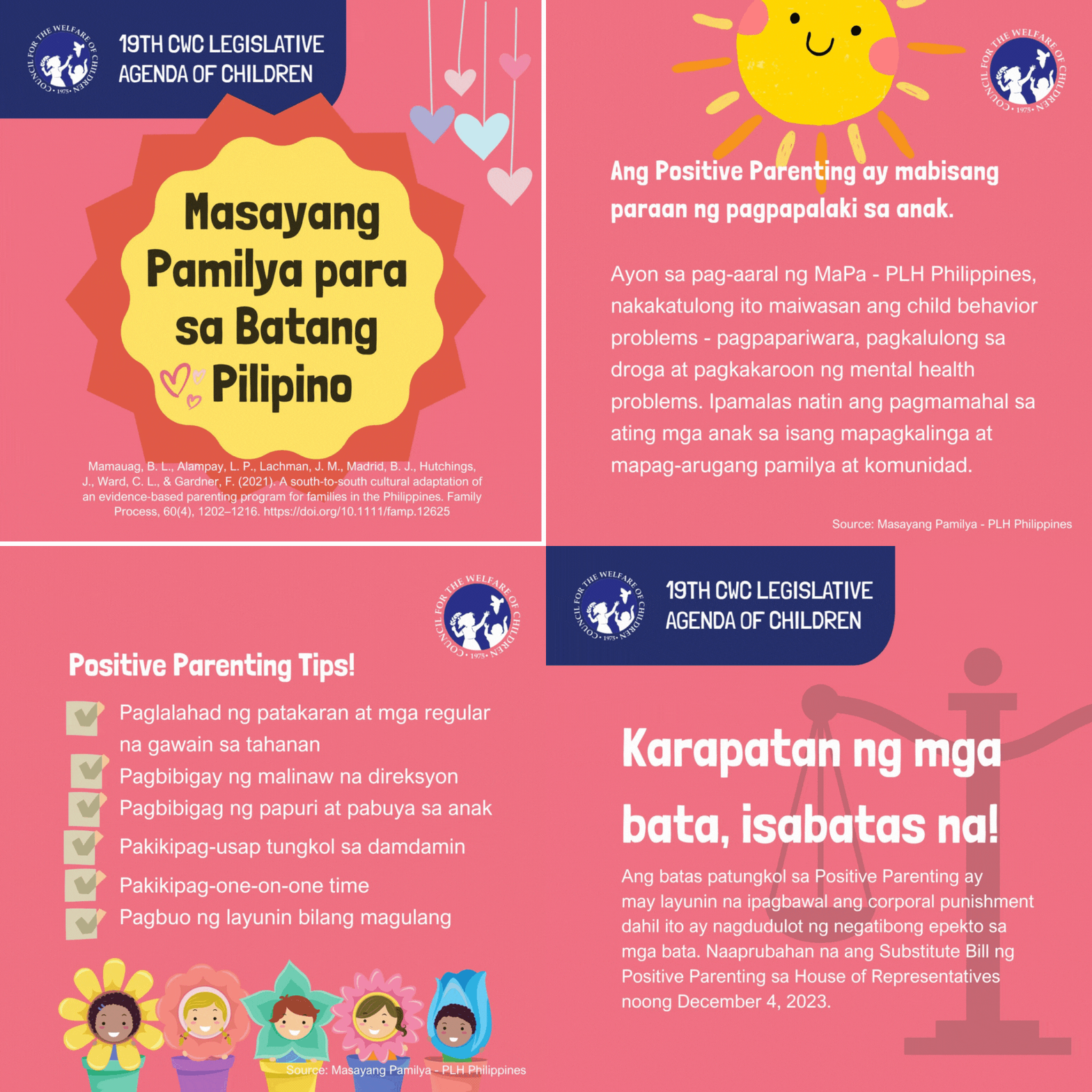
Not new. Tested.Programs built on positive discipline have been studied with thousands of parents across Asia, including here in the Philippines, and consistently lower harsh punishment.
Lachman et al., randomized controlled trial of the MaPa parenting program, The Lancet Regional Health – Western Pacific, 2021
"Positive Discipline" · Coram, the UK's oldest children's charity (English) · Watch on YouTube ↗
"The Single Most Important Parenting Strategy" · Dr. Becky Kennedy, TED (English) · Watch on YouTube ↗
Punishment stops a behavior for a moment. Teaching changes it for good.
Step 1 of 5
P
Pause
Stop before you react. Take one breath. Give yourself five seconds before you do or say anything.
The urge to react comes from the body, not the mind. One breath creates enough space to choose what happens next.
In the moment
Your child broke something after you told them not to. You feel the anger rise. Before anything else, breathe.
Step 2 of 5
A
Ask
Ask the child what happened. Let them speak first. Listen without interrupting.
Children often act out for reasons adults don't see. Asking before assuming shows respect, and gets you closer to the truth.
In the moment
"What happened?" Said calmly, not as an accusation. Wait for the answer even if it takes a moment to come.
Step 3 of 5
U
Understand
Consider why they did it. Were they scared? Confused? Bored? Testing limits? Still learning?
Behavior is communication. What looks like defiance is often a need the child doesn't know how to express yet.
In the moment
"What was going on for them?" Not to excuse the behavior, but to understand it before you respond.
Step 4 of 5
S
Support
Respond to the real need behind the behavior, not just the behavior itself. Guide, don't punish.
Children learn better through guidance than fear. A child who feels supported is safe enough to do better next time.
In the moment
Calm redirection. A clear boundary, explained with love. Your presence, not your anger.
Step 5 of 5
E
Encourage
End with something that builds trust, not fear. Let them know the mistake doesn't change how much you love them.
Children who feel loved after a mistake are more likely to be honest, try again, and trust the adults in their lives.
In the moment
"I know you can do better. I'm here." That's enough.
Circle of change
Your story matters.
The next pages ask you to reflect honestly on your past, your present, and the change you want to make. There are no wrong answers.
What is the circle of change?The journey from how you were treated as a child, to how that shaped the way you discipline today, to the boundaries you want to set going forward.
Your past · Your now · The shift · Your limits · Your commitment
Your answers become part of a collection of change shared anonymously as a module for communities across the region.
Circle of change · 1 of 5
Your past
How were you disciplined as a child? What did the adults around you do when you made a mistake?
Please answer both questions before moving on.
Circle of change · 2 of 5
Your now
How do you discipline children in your life today? Be honest. This is not a test.
Please answer both questions before moving on.
Circle of change · 3 of 5
The shift
What do you want to change? What kind of adult do you want to be in the moments that matter?
Please answer both questions before moving on.
Circle of change · 4 of 5
Your limits
Positive parenting still has boundaries. Children need limits given with love and consistency, not pain or fear.
Please answer both questions before moving on.
Circle of change · 5 of 5
Your commitment
"Is that the memory you want your child to have of you?" You don't have to be perfect. You just have to pause, one moment at a time.
Moving forward
Your next step, guided.
Whatever you need next, here is exactly where to go. You do not have to figure this out alone.
If a child is in danger right now
🇵🇭 Makabata Helpline1383
🇻🇳 Child Protection Line111
🇰🇭 Child Helpline1280
Below are real government and community programs. Do not worry about the short names, just ask your local office and they will know them.
🇵🇭 To keep building this skill, in the Philippines
Ask your 4Ps or barangay social worker about Family Development Sessions
These sessions now use MaPa (Masayang Pamilya), a positive parenting program made for Filipino families and shown to actually work. It was built by university researchers with UNICEF Philippines. See MaPa's programs at masayangpamilya.org ↗
Bring PETA's "Love Does Not Hurt" campaign to your community
PETA's ARTS Zone project uses theater and workshops to teach positive discipline in schools and barangays, including in Valenzuela. petatheater.com/arts-zone ↗
Ask your local POPCOM office about Responsible Parenting Classes
The Commission on Population and Development runs free classes for couples and parents on family planning, spacing children, and family wellbeing, alongside DSWD's Family Development Sessions.
🇻🇳 To keep building this skill, in Vietnam
Ask about "Nobody's Perfect" parenting training
Delivered with MOLISA and local employers or community centers for caregivers of children under 8.
Call 111 for more than emergencies
The national child protection line also offers ongoing parenting counseling, not only crisis reporting.
🇰🇭 To keep building this skill, in Cambodia
Join a Positive Parenting Programme session
Run through your commune Ministry of Women's Affairs office, with training on communication and nonviolent discipline.
Message the ParentingTips chatbot
Free on Telegram, or call 1279 to register for tips by voice call.
🌏 Reading this from somewhere else? You still have a place to go
The Positive Discipline Association has certified trainers in more than 90 countries. positivediscipline.org ↗
Check your country's laws and get more research
The Global Initiative to End All Corporal Punishment of Children tracks laws and research worldwide. endcorporalpunishment.org ↗
Find family planning and reproductive health support
The International Planned Parenthood Federation links to member clinics and helplines worldwide. ippf.org ↗
Want to revisit the research or the film on positive discipline? They are on the earlier pages of this toolkit, anytime you need them again.
Your pocket card · Keep this close
In a moment of stress, this is all you need. Screenshot it and put it somewhere you will see it.
P
PauseBreathe. Five seconds before you react.
A
AskAsk the child what happened. Listen first.
U
UnderstandWhy did they do it? Behavior is communication.
S
SupportRespond to the need. Guide, don't punish.
E
EncourageEnd with love. The mistake doesn't change that.
Where your responses goYour story, collected anonymously alongside others, will be presented at the 2nd Global Ministerial Conference on Ending Violence Against Children, Manila, November 2026.
Designed by young people · Violence Ends With Us · Asia-Pacific